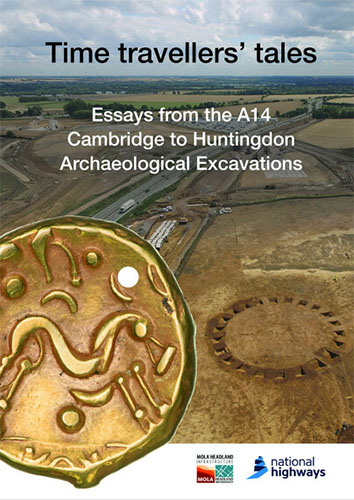
Time Travellers’ Tales: Essays from the A14 Cambridge to Huntingdon Archaeological Excavations is a collection of period-specific essays based on archaeological works carried out as part of developer funded road improvement works. The six chapters, each by different authors, comprise the introduction, the Bronze Age, the Iron Age, the Roman period, early medieval (specifically 8th century) settlements and a later medieval (11th to 15th century) settlement.
The book is not an excavation report, as they are published elsewhere (and referenced comprehensively throughout this volume). Each essay discusses a specific question, using the opportunity afforded by large scale excavation areas along a 38 km road scheme, encompassing some 232 ha of open area excavation.
The essays in this volume highlight some interesting archaeological questions:
Claire Christie discusses the absence of evidence for middle Bronze Age settlement, despite there being significant funerary activity, drawing conclusions about the links between behaviour and landscape.
Lawrence Billington and Matthew Brudenell look at Iron Age settlements, highlighting the number and variety of settlements across the region and making suggestions about possible directions for future study.
Owain Scholma-Mason and Alex Smith discuss at the Roman towns of Godmanchester and Cambridge, together with their hinterlands, highlighting the changing patterns of settlement and activity throughout the Roman period and the difficulties inherent in trying to define site types where these differences were not so clearly defined in antiquity.
Emma West discusses two early medieval settlements, both active in the 8th century CE. One, Conington, may be an administrative center rather than a settlement, while the other, at Brampton, a development of an existing settlement.
Finally, Debora Moretti and Julie Franklin discuss the development, life and decline of a medieval hamlet and its relationship to the adjacent forest.
Such brief summaries cannot, of course, do justice to the full discussions in this volume. However, they do highlight that this is a book for specialists, rather than for one looking for an overview or summary of the archaeology of Cambridgeshire. Some of the discussion points seem to be particularly nuanced, aimed at very specific aspects of their respective subjects to a degree that may alienate a more general reader. Similarly, some of the essays rely on unhelpful or inconsistent terminology: features in the early medieval chapter, for example, are variously described as ‘Saxon’, ‘Anglo-Saxon’, ‘Mercian’ or ‘East Anglian’, seemingly interchangeably. Regardless of the reader’s views of the use of cultural determinant exonyms, one is left with the feeling that a consistent approach would have been clearer.
The book is comprehensively illustrated, with large numbers of full page maps and plans. However, the landscapes and sites being discussed are so large that even with an A4 size, some of the sites are difficult to interpret. The plans are generated from digital or digitized site plans, with individual features displayed at scale (and all features from all periods displayed), leading to overly complex figures and features and feature groups that are too small to see clearly. A degree of interpretive drawing would have illustrated the points more clearly. Some of the plans have scale bars that are clearly incorrect, making comparison with other plans difficult.
Overall, this is an interesting landscape study and the authors have made full use of the opportunities offered by the large scale excavations of the A14 development to look at the archaeology of rural settlement in detail.
Time Traveller’s tales; essays from the A14 Cambridge to Huntingdon ar – Shop MOLA