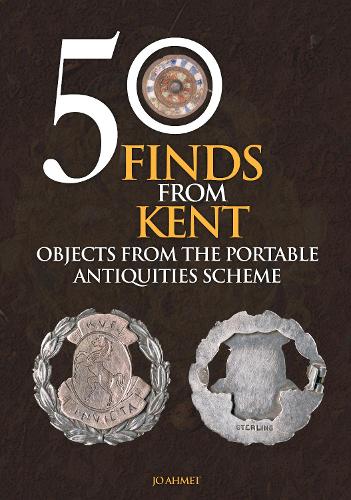
As can be seen from the illustrations to page count, this is very much a picture book with some text attached. The author was at the time of writing the Kent Finds Liaison Officer for the Portable Antiquities Scheme (PAS) and has done a very decent job of selecting both representative and exceptional pieces found in the county over recent years.
The book commences with a short introduction providing a background to the Portable Antiquities Scheme and then continues with a series of chronological chapters taking the reader from Stone Age Kent to Post-Medieval and Later Kent. Each chapter has a brief introduction to the period in question as it is understood in Kent, which is then followed by a selection of objects from that period.
The result is an easily accessible primer to the archaeology of Kent as exemplified by its small finds. As such, it is ideal for those new to the subject. If, on the other hand you are passingly familiar with the subject its usefulness is less obvious. It is evidently not a comprehensive account of the PAS finds from the county as is well demonstrated in Figure 1.1 which plots all of the finds from the county with the 50 selected picked out in red. The rationale for inclusion being that the selected objects should be representative of their period (whilst also allowing for the inclusion of ‘headline grabbing’ items – treasure you might say).
The representative selection includes some lithics, a fair smattering of coins, ceramics and brooches while the ‘treasure’ includes an Early Bronze Age gold disc found near Cobham and the Ringlemere gold cup. The star find for me was the late Iron Age bronze helmet found near Bridge used to contain cremated human remains. Interesting enough for its rarity but equally intriguing for the identification of the remains as female.
Now for some quibbles. None of the object images contain scales which I would have thought pretty standard practice and essential if, as here, additional objects are shown by way of comparison. Then there is the copy editing or rather the evident lack of it. In what is essentially a picture book a few errors in the text might be neither here nor there, but in this case the errors were so egregious and so frequent in some chapters as to begin to form a distraction.
The publishers have hit a rich seam of material in the substantial body of finds from the PAS. There are regional equivalents for many counties including Yorkshire, Staffordshire, Cheshire and Essex as well as chronological equivalents such as 50 Early Medieval Finds. Does the format work? I suppose it does if you don’t expect too much of it.