
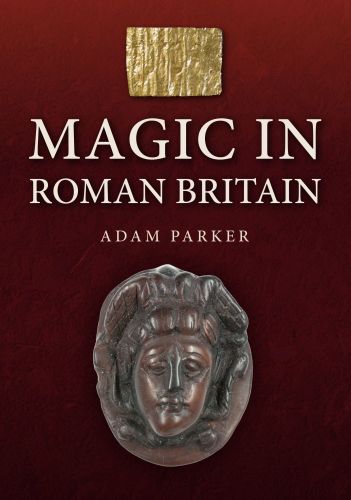
The author is assistant curator of archaeology at the Yorkshire Museum, and this book is the result of his doctoral research. He knows his material intimately which comes across very clearly in the text. In common with other volumes from the Amberley stable much use is made of illustrations of finds reported under the Portable Antiquities Scheme. The purpose of the book is to provide a general introduction to the subject of Magic in the Roman world through a study of the material culture of the province of Britannia.
The book is divided into an Introduction followed by eleven thematic chapters. The Introduction opens with a discussion of a collection of amulets found with a fourth century infant burial discovered in Colchester (a find we return to in the final chapter). This then allows the author to talk about what is meant by magic – here defined as ‘a group of practices which aim to draw on the power of supernatural creatures, deities or natural elements in order to provide a benefit to the user.’ - and some specific aspects such as the use of amulets and how to avert the Evil Eye.
The thematic chapters deal with Phallic Magic, Magical Gemstones, Lamellae and amulet cases, Curses, Teething Problems, Gorgoneia, Lunulae and Bullae, Sound and Motion, Animal Power, Uncanny Stones and Crepundia. Some of the material is familiar but some perhaps less so – the discussion of vulvate objects in the Phallic Magic chapter being a case in point. The discussion of the properties of jet in the Uncanny Stones chapter is unsurprising given the source of the material and the author’s workplace but the frequency with which Neolithic axes (Thunderstones in more recent usage) had been found in Roman contexts (more than 100 of which 44 were found in two pit groups at the religious complex at Ivy Chimneys, Witham).
Reviewing some different categories of material together, which might otherwise be treated separately, raises some questions. For example, lamellae (protective spells written on a thin sheet of metal, rolled up and put in an amulet case), are made of gold and are written in Greek while defixiones (curse tablets) are made of base metal and written in Latin or Celtc languages. Did the differing purpose dictate the choice of base metal over precious and the use of Latin or Greek? Or is there a survival bias at work – only eight lamellae are known from Britain against hundreds of defixiones?
This is an excellent book packing a lot of information and nice pictures into a relatively short volume. It succeeds admirably in its stated intent although there are points where it works less well. There is very little discussion of matters such as structured deposits (and none at all of deviant burials) which might hint at magic practices involving material with less obvious associations. Nor is this reviewer convinced that oculists' stamps have anything more than an advertising function.
Finally, some half-praise for the publisher whose normally haphazard copy editing has in this case mostly survived scrutiny (with the exception of the heading of Chapter 8 where Lamellae and Lunulae are confused).