In this series of blogs, different authors will respond to the ideas presented in John Schofield’s book Wicked Problems for Archaeologists: Heritage as a transformative practice, which was the inspiration for the Plenary session at CIfA Conference 2025 (recording available). The book is nominated for a Current Archaeology prize, and you can vote here.
In a world of ‘Wicked Problems’ – one temptation for archaeologists has always been to take a self-effacing stance: Why would we fund archaeology when there are so many bigger problems? Climate change, economic inequality, health and wellbeing crises, war, genocide, imperialism and their retinues of associated ills.
Probably for this reason, we are driven to find ways to prove that archaeology is not just a ‘nice to have’ but also a ‘good to have’. It has been widely accepted, in recent decades at least, that archaeology defines its place in the wider world through its instrumental benefits – or impact. It is what archaeology does, not what archaeology is, that makes it a meaningful practice – worthy of enabling and investing in.
In CIfA’s advocacy, we have to weigh the fact that we may be arguing for additional funding for HER services during an adult social care crisis. We seek to preserve investment in archaeological investigation on public infrastructure projects that are already 3x overbudget and draining the taxpayer’s purse.
To do this we must demonstrate that even in these contexts we have things to offer. The impact of our ‘wins’ might often be ‘small’ (investing in archaeological research won’t fix a broken climate in the way nuclear fission might, and it doesn’t change the structural causes of inequality in the way workers’ rights do), but we can make a knowledge contribution, or create a conversation, or spark a social connection using our ‘superpowers’ of storytelling, time perspective, and connection with people and places (things that, perhaps, nuclear fission and worker’s rights don’t do so easily).
We can make a case for this – and we do.
As a tool for inspiring optimism for individual practitioners, or for archaeological organisations, I think we can all latch onto the concept of ‘small wins’. This will be addressed directly in other blogs. But the Wicked Problems book concludes with an address to the high-level picture for ‘transformation’, exploring how we can position ourselves as a sector to present a message and fight for influence. Creating space for small wins, and bigger transformations is – among other things – a policy issue.
Mission → Message → Motivation
Having a ‘well designed mission’ can inspire conscious collective action – to direct and collectivise small wins into widespread ones, or embed their delivery into systems so that they can become normalised. It sits between the Wicked Problem and the small win. We should understand that the mission acts to outline our purpose, carry our message, and direct our action. It should be “bold, inspirational, and relevant”.
Mission → Influence
Beyond this, our mission needs to carry influence, gathering support not only from archaeologists, but from other sectors and decision-makers. The articulation of a Mission is also a way to communicate our contribution as we seek change that would enable us to succeed and do more.
In the 2000s, the historic environment sector ran the ‘History Matters’ campaign. It leveraged thinkers and celebrities and their emotive arguments for why the past mattered, and placed them in the public eye. Today, our advocacy message can sometimes feel parochial by comparison. Perhaps we bleed away our potential and passion when we seek primarily to preserve an adequate status quo? Perhaps a clearer mission could prevent this, and help sharpen our goals to influence, as well as motivate us to delivering our small wins?
I think that it would be an exciting conceptual challenge for CIfA members to define missions for the profession. At present, CIfA has a semblance of a ‘mission’ outlined by our Royal Charter – to undertake our work for the public good. We also have a strategic plan, that commits us to delivering higher standards, an inspired profession, influence outside our profession, and good governance. We have principle advocacy objectives;
- to maintain and improve the protection and management of the historic environment
- to maintain or advance, in the interests of the public and clients, the quality of archaeological practice, particularly where occasioned though planning or other processes managing change to the historic environment, and
- to ensure that work is done by competent professionals and to professional standards.
And we have specific advocacy objectives, e.g. to support provision of archaeological services, implement Statutory HERs, ensure suitable provision for archaeological skills, and many more.
What we do not have, is bold, inspirational, societally relevant yet targeted and measurable – capital-M – Missions. I’d like to hear what CIfA members think these might be if we sought them, and how they might change our comms and our advocacy.
Maybe we could look to find space for something like this:
- Archaeology will shape places for the better: Every archaeological project that our members lead will be designed to maximise the influence that the knowledge gained through archaeology will have on people's understanding of place – whether by influencing the design of development, etc, or through dissemination and public engagement.
- Archaeology will make people’s lives better: By designing and encouraging clients and funders to support projects which promote social interaction, benefit health and wellbeing, bring communities together with stories from the past, and target direct engagement with diverse audiences.
- Archaeology will seek relevance: Scoping archaeological projects with reference to outcomes that matter in the present. With each discovery we will ask: Why does this matter?
- Archaeology will provide data towards solving challenges in health, biodiversity and climate science: Archaeological research will seek meaningful contributions to wicked problems, prioritising investment in projects that promise positive social or environmental outcomes.
Every small win that we pursue – from the individual who discovers their vocation working as a volunteer on an excavation, to the housing development that is given a sense of place and connected to the local community by the knowledge of the past habitation of its site – can nest within these kinds of Mission. Each archaeologist should be able to think how their role can deliver towards those ends.
These missions would also present a powerful message in seeking to establish influence with decision-makers to change policy and push the envelope of what we can achieve. Whether welcomed or spurned by our Governments, it could not be denied that our intention to be instrumental, to align our efforts with those of wider professions and societal progress, had been articulated in a way that provides the compelling evocation of logos (the logical argument), ethos (the legitimacy of the profession to make it), and pathos (the emotional resonance of the claim) that John draws out in the book.
Finally, some reflections on policy and leadership: CIfA is an organisation that generates its influence over matters of policy for reasons of the expertise of its members. In the last 18 months, CIfA has specifically sought to ensure that its platform was turned to spotlight its members as primary carriers of the profession’s advocacy and message. John’s book describes this as creating ‘policy entrepreneurs’, and it is with pleasure that I report that we are already trying to do this. But we can do a better job to platform the members and organisations who are doing inspiring work, and who are most clearly demonstrating our – perhaps soon to be articulated – ‘mission’. CIfA’s engagement with policy and politicians serves to identify windows for influence, and seeks to create opportunity to pivot where needed to react to a pressing political agenda.
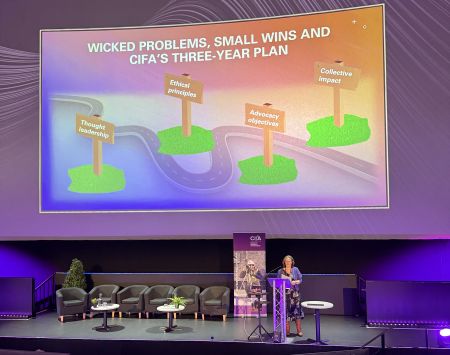
There are opportunities here if more members – researchers and practitioners – wished to step into these spaces. Through this, CIfA needs to provide a space for ‘thought leadership’ – another serendipitous overlap in language between existing CIfA activities and John’s call to action in Wicked Problems. CIfA’s Thought Leadership programme is a place where those who recognise problems facing archaeology can promote a dialogue with peers and demonstrate a collaborative sort of leadership. It is a programme that offers a place for policy entrepreneurship and a place where we can articulate and set out our Mission.
We do not have to be self-effacing. Our platform for directing the many instrumental benefits of our work is broad, and we will reflect on how best to inspire more of the talented individuals in our profession to lead us towards the future.